Category Archives: Uncategorized

June 2026 Conservation Task

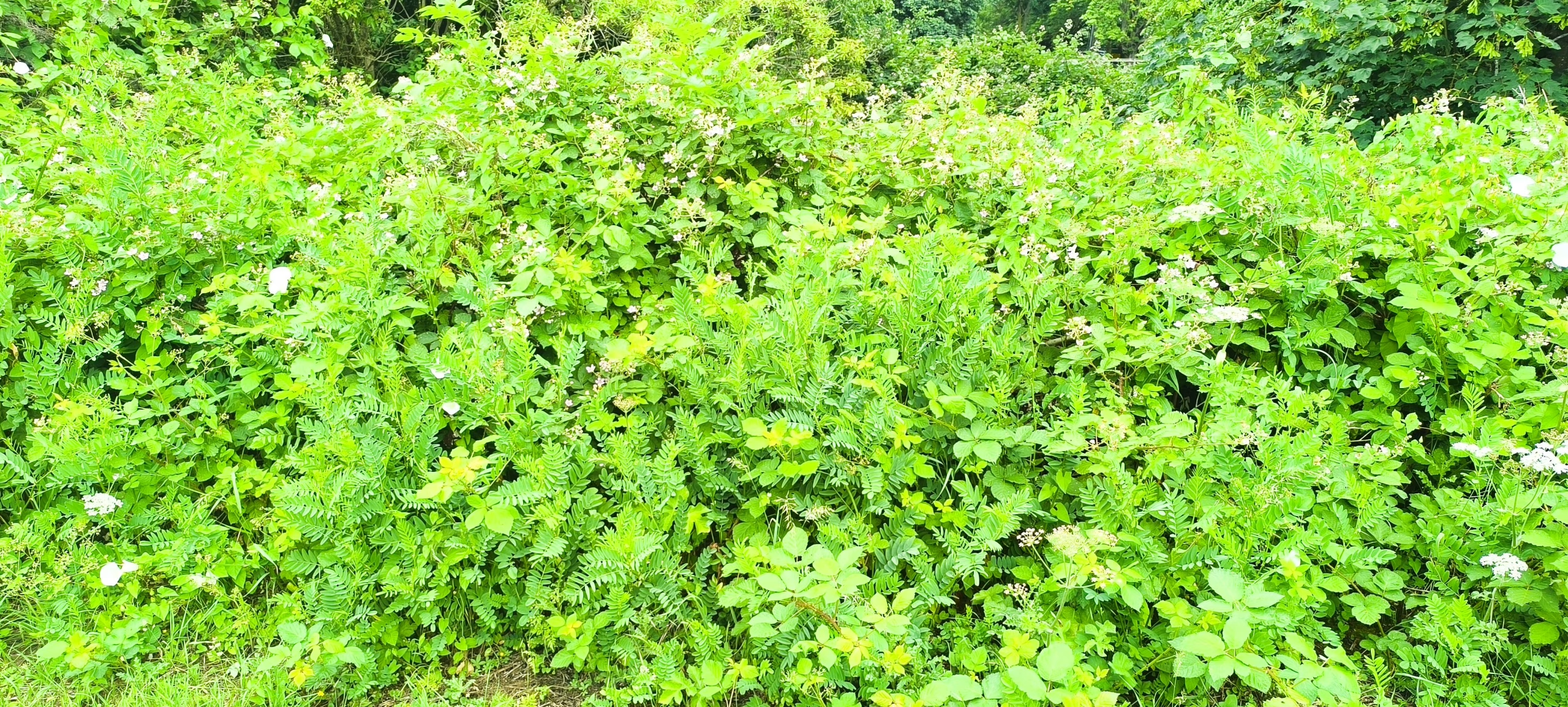
Goat's rue on Aqueduct Path Leyton June 2026.
Goat’s rue on Aqueduct Path Leyton June 2026.

On Sunday 7 June 2024, LBCV will be doing invasive species management on Walthamstow Marshes(SSSI). We will be removing goat’s rue from the Aqueduct Path area. Meet at the Waterworks Centre, Lammas Road E10 7QT, from 9:30am for 10am to collect tools etc

Conservation Task Details

Walthamstow Marsh is a Site of Special Scientific Interest (SSSI, pronounced “triple S, I”) declared under the 1981 Wildlife and Countryside Act. Covering 55.4 Hectares (136.9 acres), it is part of a Green Flag Awarded Nature Reserve that also includes Coppermill Fields and Leyton Marsh.

This Nature Reserve is a remnant of London’s once widespread river valley grasslands and is especially important for its plant and insect life containing a national rarity in creeping marshwort along with long-stalked orache, black poplar, brookweed, penny-royal, water voles, bats; soldier-flies, snail-killing flies, orthoptera, reed bunting, linnet and song thrush.

The marshes are former Lammas lands, meaning commoners had rights to graze there from 12 August to 6 April.The task will help the rangers control and protect the marshes from invasive plant species. We will have a chance to explore the SSSI nature reserve.

Goat’s rue is such an invasive plant, that for several years LBCV was devoting a whole summer task to pulling on South Marsh. Any goat’s rue now on South Marsh is dealt with by pulling on a walk through, so we are confident we are making a difference. It has also been eradicated, by us, from North Marsh and hence we are now concentrating on the final few plants on Aqueduct path.

Goat’s rue is so called as it was given to nanny goats to increase their milk yield but it was found to be toxic to ruminants with the potential to induce a build-up of excess fluid in the lungs, low blood pressure, paralysis and death.

How is it invasive ?

It is a non-native hardy perennial that forms dense crowns, each plant can produce over 15,000 seeds that remain viable for 10 to possibly 26 years.

Why remove ?

Walthamstow Marshes are under Higher Level Stewardship in that they are being grazed by traditional bred cattle, so having goat’s rue growing where cattle are grazed is not ideal and the area is also surround by bridle paths so there is a need to control the goat’s rue in these areas.

May 2026 Conservation Task

Sunday 3rd May 2026, the nature conservation task will be in the scrape on Walthamstow Marsh. Last month the area was too wet for the task, the area is still wet, wellingtons are needed for access to all areas, ankle deep water. Collect a pair from the container, bring an extra pair of socks in case you have to have a larger pair and just to avoid blisters !

Walthamstow Marsh is a Site of Special Scientific Interest (SSSI, pronounced “triple S, I”) declared under the 1981 Wildlife and Countryside Act. Covering 55.4 Hectares (136.9 acres), it is part of a Green Flag Awarded Nature Reserve that also includes Coppermill Fields and Leyton Marsh. This Nature Reserve is a remnant of London’s once widespread river valley grasslands and is especially important for its plant and insect life containing a national rarity in creeping marshwort along with long-stalked orache, black poplar, brookweed, penny-royal, water voles, bats; soldier-flies, snail-killing flies, orthoptera, reed bunting, linnet and song thrush. The marshes are former Lammas lands, in that commoners had rights to graze there from 12 August to 6 April.

The aim of the task is to help provide favourable conditions for the nationally rare creeping marshwort Apium repens.

Walthamstow Marshes are under Higher Level Stewardship in that they are being grazed by traditional bred cattle.

All(18+) are welcome to join us and no experience is required. Please meet us at the Waterworks so we can provide enough tools. If You are curious about what happens on a LBCV task, one of our regular volunteers did the following live video on the October 2020 task

Please wear appropriate clothing which is long sleeves and trousers and wear stout footwear, PLEASE NO SHORTS, as there may be ticks in the area. We will be possibly working in an area with nettles and brambles, so closed shoes/boots and long trousers and sleeves would be safest.

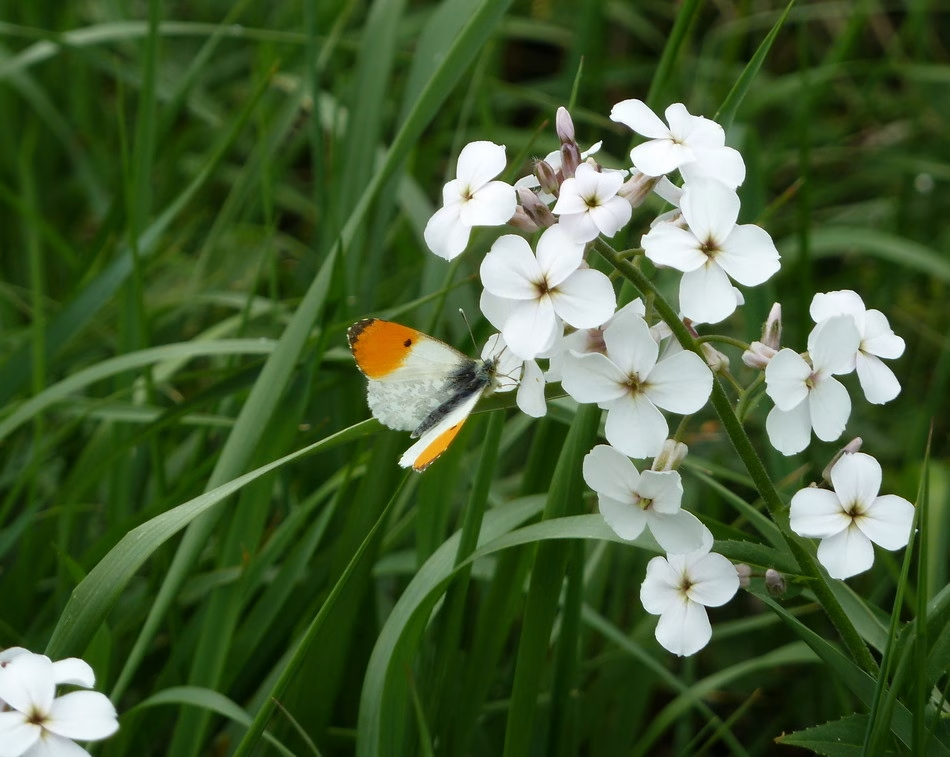
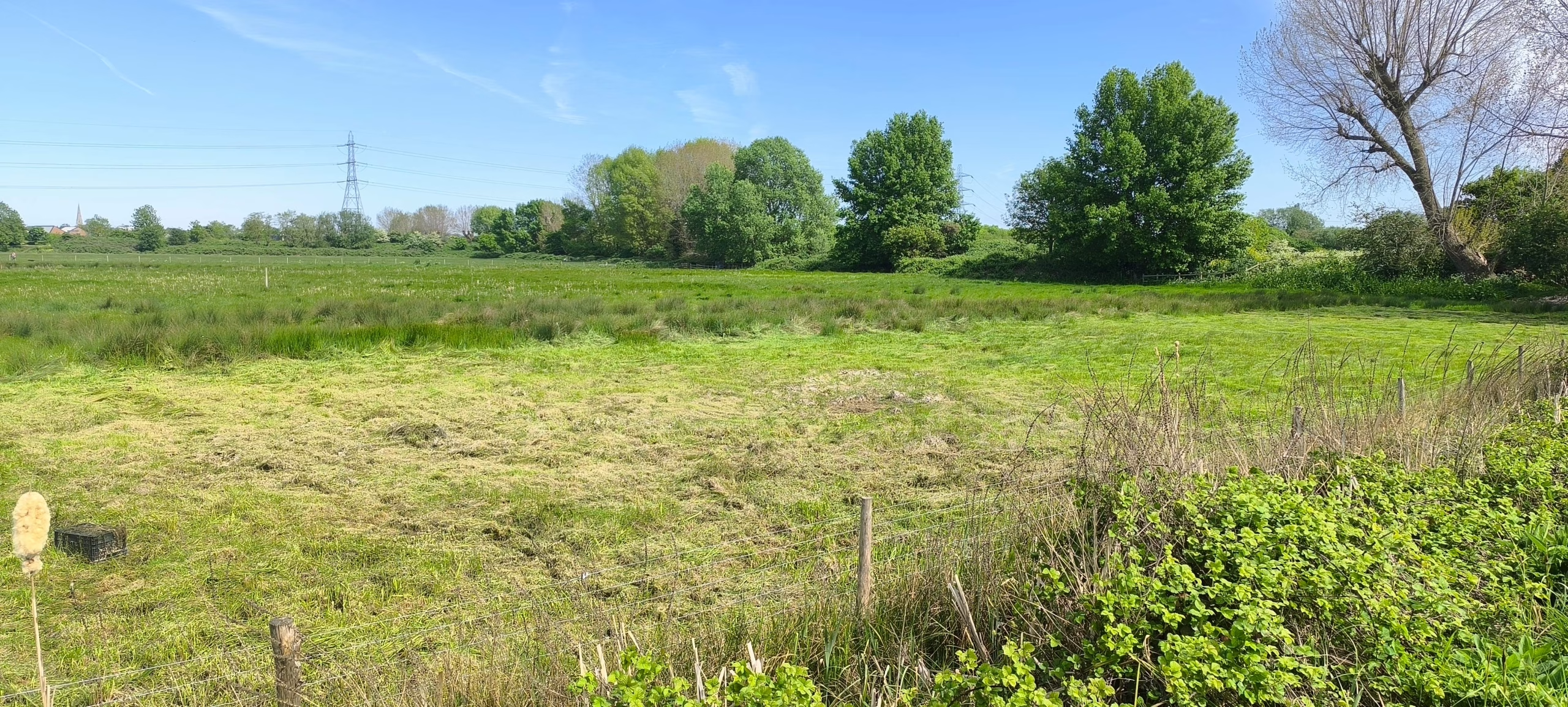
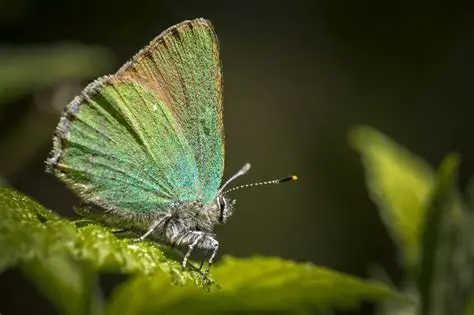
Photos of the drier task area, an Orange-tip butterfly on a cuckoo flower/lady’s smock flower and a Green Hairstreak butterfly – both active in the scrape area during the site visit

March 2026 Nature Conservation Task

On Sunday 1st March 2026 the nature conservation task is on Walthamstow Marshes and will involve a bramble bash in selected areas.

The task will help the rangers handle the increased number of cattle that will be on the marshes, this year. it is planned for there to be up to 15 Red Pole cattle. This is the last chance to attack the bramble around the corral area before the 2026 nesting season begins. As always we will be looking for any nesting activity.

All(18+) are welcome to join us and no experience is required. Please meet us at the Waterworks so we can provide enough tools. If You are curious about what happens on a LBCV task, one of our regular volunteers did the following live video on the October 2020 task

Please wear appropriate clothing which is long sleeves and trousers NO SHORTS as we are handling bramble and stout footwear for the task and weather. We will be working in an area with long grass and possibly nettles, so closed shoes/boots and long trousers and sleeves would be best.

Volunteer With Us
Everybody(18+) is welcome to volunteer with LBCV. No experience is required. Please wear sturdy waterproof footwear and appropriate clothing for the work and weather. We will be working with brambles and nettles and sharp tools and the paths are wet at the moment.

We are out of lockdown but some restrictions still need to apply for LBCV to safely be able to run volunteer tasks in the Lea Valley Park, with the restrictions below.

If you are ill, feel ill or have been in contact with somebody who is self-isolating please do not volunteer.
Please wash your hands before the task in warm water or hand sanitiser.
Wash your hands before eating or drinking in warm water or hand sanitiser
LBCV can supply wellington boots to work in, please arrive in plenty of time at the Waterworks, to select your pair.

LBCV will provide tools, training, gloves, coffee, tea and biscuits. Please bring some lunch and water.

Please arrive from 9:30am onwards at the Waterworks Centre Lammas Road, off Lea Bridge Road, Leyton, London E10 7QT, for a 10am departure to collect tools and gloves. The meeting place is by the bike racks in front of the Waterworks Centre. If you use what three words ///guises.manage.entry is the location.

Please lock bicycles to the stands in front of the Waterworks Centre. There is ample free car parking. Dogs are not allowed in the Nature Reserve so please do not cross the bridge with dogs or ride bicycles in the nature reserve. Well behaved dogs are still welcome on some tasks, including this one, as we are in an open nature reserve.

We should be finished by 4pm.

Volunteering and doing a conservation task with LBCV in North East London, is great way to meet new people, learn new skills, use old skills, be more active, get closer to nature, make a difference and have some fun with like-minded people in the Lea Valley Regional Park.

Subscribe to our task reminder – please check your spam/junk folder or the confirmation email !

January 2026 Task

On Sunday 4th January 2026, at the Waterworks Nature Reserve, off Lea Bridge Road, and will involve removing vegetation – including trees and bramble to improve the access between Beds 23 and 24.

The task will reclaim the areas from the encroaching scrub. Recent plant sightings at the nature reserve have included the unusual broomrape (Orobanche L.) which is a parasitic plant that has no chlorophyll and relies on its host for nutrients and water.

Recently bird sightings have included blackcaps, firecrests, bullfinches, treecreepers and common snipe in the nature reserve.

All are welcome to join us and no experience is required. If You are curious about what happens on a LBCV task, one of our regular volunteers did the following live video on the October 2020 task

Please wear appropriate clothing which is long sleeves and trousers NO SHORTS as we are handling buck/blackthorne aka sloe bushes and wear stout footwear for the task and weather. We will be working in an area with bramble and nettles, so closed shoes/boots and long trousers and sleeves would be best. Kneeling may also be required so if you have knee pads please bring them.

December 2025 Task

On Sunday 7th December 2025 Lea Bridge Conservation Volunteers will be coppicing in Horseshoe Thicket on Walthamstow Marshes.

This month’s task will involve coppicing trees. This ancient woodland management technique will involve the use of the 4-cut felling method, shedding, brashing and dead hedging. The brash wood will be used to create dead hedges to control access to the regrowth area. The larger wood pieces will be used to build habitat piles, which increases the biodiversity of this urban woodland by becoming lying deadwood ecosystems. No experience is required; training will be provided.

Traditionally coppiced wood would be used in green woodworking by bodgers to make spoons, bowls, chairs etc. See below, if you would like to learn green woodworking in East London.

All(18+) are welcome to join us and no experience is required. If You are curious about what happens on a LBCV task, one of our regular volunteers did the following live video on October’s 2020 task

Please wear appropriate layered clothing and stout footwear for the task and weather, it’s going to be cold. We will be working in an area with bramble and nettles, so closed shoes/boots and long trousers and sleeves would be best. Kneeling maybe required, so if you have knee pads, please bring them.

November 2025 Task

On Sunday 2nd November 2025, LBCV will be working around the pond in Bed 24 at the end of the broadwalk in the Waterworks Nature Reserve. This work is the start of reviving the pond’s ecosystem from the encroaching vegetation.

To join us, meet at the Waterworks Centre, Lammas Road from 9:30am – 10am.

Conservation Task Details
The aim of the task is to remove bramble and other woody tree growth by slashing it and cutting it down, to maintain the area as an open pond habitat and remove competition for the planted saplings and ground flora.

While doing the task we need to be cautious as the pond was built using a liner. The pond was constructed to provide a place to relocate the newts from the London Olympic site.

October 2025 Task

On Sunday 5th October 2025, LBCV will be working alongside the ditch on Walthamstow Marshes to remove willow and other tree growth in this SSSI Nature Reserve to maintain it as a marsh environment. 

To join us, meet at the Waterworks Centre, Lammas Road from 9:30am – 10am. 

Conservation Task Details

The aim of the task is to remove willow and other woody tree growth by cutting it down, to maintain the area as a marshland habitat. 

While doing the task we need to be cautious as the ditch contains the invasive azolla, mosquito fern, duckweed fern and we must take precautions to stop it spread to other parts of the ditch and nearby waterbodies.

June 2025 Nature Conservation Task #2

On Sunday 1st June 2025, Lea Bridge Conservation Volunteers will be doing a nature conservation task in and around the Waterworks Nature Reserve. The task will involve removing invasive vegetation from the meadow areas and a poisonous shrub from around nature reserve

This is a change of task location from the published 2025-26 task calendar.

More details and task reminder after the site visit closer to the date.

Subscribe to our task reminder email ! Check your spam/junk folder for the confirmation email.

May 2025 Nature Conservation Task

On Sunday 4th May 2025, Lea Bridge Conservation Volunteers will be doing a nature conservation task in the Waterworks Nature Reserve. The task will involve removing light vegetation from a shingle bank to create an invertebrate and reptile basking area.

Why are we creating a basking area? Well, many species of bee, solitary wasp, spider and beetle are dependent on bare ground to hunt and nest because these areas provide the necessary warm micro-climate and easy tunnelling. However, bare ground does not remain bare for a long time as vegetation colonises and soon the bare ground is lost. The shingle bank created from the spoils of the recent ponds created an open bare ground. on the filter bed wall.

More details and task reminder after the site visit closer to the date.

Subscribe to our task reminder email ! Check your spam/junk folder for the confirmation email.